The most complete
information guide about Athens, Greece
Churches in Athens
Panagia Kapnikarea (Kapnikarea
– Saint Mary)
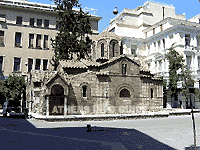
One of the most important Byzantine monuments in Athens is in
the middle of Ermou street. The church is dedicated to Saint Mary
but it is better known as Kapnikarea. It is a complex tetrastyle
cross-in-square church that dates back to 1050.
The
higher parts of the masonry follow the cloisonné style
while the lower parts consist of large courses (continuous horizontal
layer of similarly-sized building material, such as stone or brick)
arranged so that they form crosses. The elements that lead experts
to date the church to 1050 are the kufic brick patterns, the limited
use of dentils and the particular arrangement of the windows.
With
its light proportions, the dome is typically Athenian. The color
variations with the use of kufic brick patterns is less visible
here than in earlier monuments. Instead the emphasis is placed
on the sculptural values of the stones.
Soon
after the church’s foundations, a chapel dedicated to Saint
Barbara was added on its northern side. The outer narthex was
added on the western side of the church and chapel during that
time as well. Initially it was an open portico. The small columned
porch on the narthex’s southern entrance was built in the
12th century.
When
Ermou street was opened up in 1834 the church, that by then had
been damaged and deserted during the Greek War of Independence,
came close to being demolished. Ludwig of Bavaria, King Otto’s
father intervened and the church was rescued. The building also
escaped demolition in 1863 with the intervention of the Bishop
of Athens.
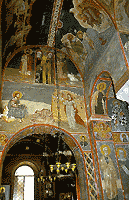
The
church’s interior marble screen was crafted later and it
is a copy of the screen that is in the Monastery of Kaissariani.
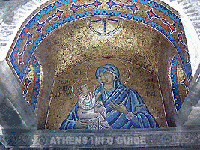
The pictorial decorations date from 1942 and were created by the
famous icon-painter Fotis Kontoglou and his students. The mosaic
over the entrance was made by Elli Voïla in 1936. The church
of Kapnikarea now belongs to the University of Athens.
The
name Kapnikarea
There
are various theories regarding the origin of the name
Kapnikarea. Most probably the name relates to the “Kapnikon”,
a certain tax imposed during the Byzantine era. According
to this explanation, the church was sponsored by an executive
who might have been in charge of collecting this tax or
simply carried the family name Kapnikares.
In
older documents we encounter variations of the name, most
frequently the name “Kamoucharea”, originating
from the word “kamoucha” (luxurious textile).
These other theories however regarding the church’s
name are no longer accepted. The church also used to be
called “the Princess’s church” based
on a tradition that is connected to most important churches
in Athens with Athenian empresses of Byzantium.
During
the 19th century the church was also known as “Panagia
of Prentzas (Saint Mary of Prentzas) probably because
of its association with a sponsor or donor of an important
icon that might have been kept in the chapel though none
of this has been proven. Even today, Athenians may say
that an old, ugly woman “looks like Kapnikarea”,
probably in reference to the poor state the church was
in at the beginning of the 19th century.
Ermou street
Monastiraki - Syntagma For
typical words, please consult our Greek
glossary.



 With
its light proportions, the dome is typically Athenian. The color
variations with the use of kufic brick patterns is less visible
here than in earlier monuments. Instead the emphasis is placed
on the sculptural values of the stones.
With
its light proportions, the dome is typically Athenian. The color
variations with the use of kufic brick patterns is less visible
here than in earlier monuments. Instead the emphasis is placed
on the sculptural values of the stones.
 In
older documents we encounter variations of the name, most
frequently the name “Kamoucharea”, originating
from the word “kamoucha” (luxurious textile).
These other theories however regarding the church’s
name are no longer accepted. The church also used to be
called “the Princess’s church” based
on a tradition that is connected to most important churches
in Athens with Athenian empresses of Byzantium.
In
older documents we encounter variations of the name, most
frequently the name “Kamoucharea”, originating
from the word “kamoucha” (luxurious textile).
These other theories however regarding the church’s
name are no longer accepted. The church also used to be
called “the Princess’s church” based
on a tradition that is connected to most important churches
in Athens with Athenian empresses of Byzantium.)
 Monastiraki - Syntagma
 For
typical words, please consult our
For
typical words, please consult our 


