The most complete information guide about Athens, Greece
Weather
and time zones
in the European Union
Weather
Europe's weather is generally temperate, although the coldest
months in Finland and Sweden can average - 16 °C, while temperatures
in Cyprus and Greece in the hot summer months can average in the
high 30s. The table below shows average temperatures in January
and July in the capitals of the EU countries.
Country
Capital
Average
max. temperature
January °C
Average
max. temperature
July °C
Austria
Vienna
1
25
Belgium
Brussels
4
23
Cyprus
Nicosia
15
37
Czech
Republic
Prague
0
23
Germany
Berlin
2
24
Denmark
Copenhagen
2
22
Spain
Madrid
9
31
Estonia
Tallinn
-4
20
France
Paris
6
25
Finland
Helsinki
-3
22
United
Kingdom
London
6
22
Greece
Athens
13
33
Hungary
Budapest
1
28
Italy
Rome
11
30
Ireland
Dublin
8
20
Luxembourg
Luxembourg
3
23
Lithuania
Vilnius
-5
23
Latvia
Riga
-4
22
Malta
Valletta
14
29
The
Netherlands
Amsterdam
4
22
Portugal
Lisbon
14
27
Poland
Warsaw
0
24
Sweden
Stockholm
-1
22
Slovakia
Bratislava
2
26
Slovenia
Ljubljana
2
27
Check your national press for weather forecasts or contact national
tourist offices for more detailed weather information. You can
see the current temperature in Athens on our weather
page.
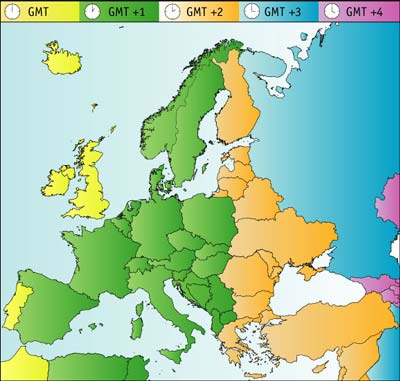
Time zones
There are three different time zones across the EU.
Summer time
Daylight saving time begins across the EU on 27 March 2005 when
clocks are moved forward an hour and it ends on 30 October 2005
when clocks are put back an hour.